
The honey badger (Mellivora capensis) is also known as the ratel. The name "ratel" comes from Afrikaans…
Are Elephants Destructive Feeders?

There is a commonly-held myth that elephants are destructive feeders. This could not be further from the truth. They are phenomenally constructive feeders and they do not deserve to be maligned with this false claim.

I am obviously being purposely provocative, but bear with me and allow me to explain my outrageous claim.
We need to start by understanding two phrases.
- Carrying Capacity. This is the number of a population that can be supported by a particular ecosystem without the system deteriorating.
- Population Control Mechanisms. These are the mechanisms that kick in so as to reduce numbers when a population exceeds the carrying capacity.
When lions are overpopulated, they are designed to be terrible breeders. On the other hand, when they are underpopulated, they become extremely successful breeders. There are a number of mechanisms that cause this. The main one is that they desynchronise their oestrus cycles when overpopulated and infant mortality becomes almost 100%. Once the population numbers decrease to below the carrying capacity, oestrus cycles synchronise and the infant mortality rate drops to about zero. It is an efficient and very rapid mechanism.
The population control mechanisms of elephants, on the other hand, are extremely slow acting: –
- they increase their home range,
- they start breeding later than usual,
- they stop breeding earlier, and
- the calving interval increases from every four years or so to every eight to ten years.
The population drops and the environment recovers.
The problems start with Man. As soon as you unnaturally confine elephants to an area that is too small for them, they will have a negative impact on the environment long before the population control mechanisms can take effect.
I must admit that I also believed the myth that elephants were destructive feeders. However, when I was guiding at Pamuzinda, I noticed that the whole area was full of examples of mopane trees growing in a strange configuration. It was common to see four to seven tall, mature trees all growing in a straight line and close together. This phenomenon was the direct result of elephants knocking mopane trees down many years ago. A process called “layering” then took place. The fallen trunks came into contact with the ground and vertical shoots (‘Epicormic shoots’) started growing upwards. As the weight of these shoots increased, the fallen limbs were pushed further into the ground and rooting took place.

So, what could have been described as being a destructive practice was, in fact a constructive practice. One tree was turned into several trees. God did not make a mistake when he created elephants.
Seed Dispersal Champions.
- Forest gardeners.
- African forest elephants are known as the “gardeners of the forest” because they consume a wide variety of fruits and disperse the seeds through their dung. This helps to regenerate plant life and maintain biodiversity in tropical forests like those in the Congo Basin.
- Long-Distance Dispersal.
- Their large home ranges mean that seeds are spread over vast distances, allowing fruit-bearing trees to grow in new areas and supporting forest expansion. (Not only are they remarkably effective agents of seed dispersal, but they also contribute significantly to seed germination; more about that later.)
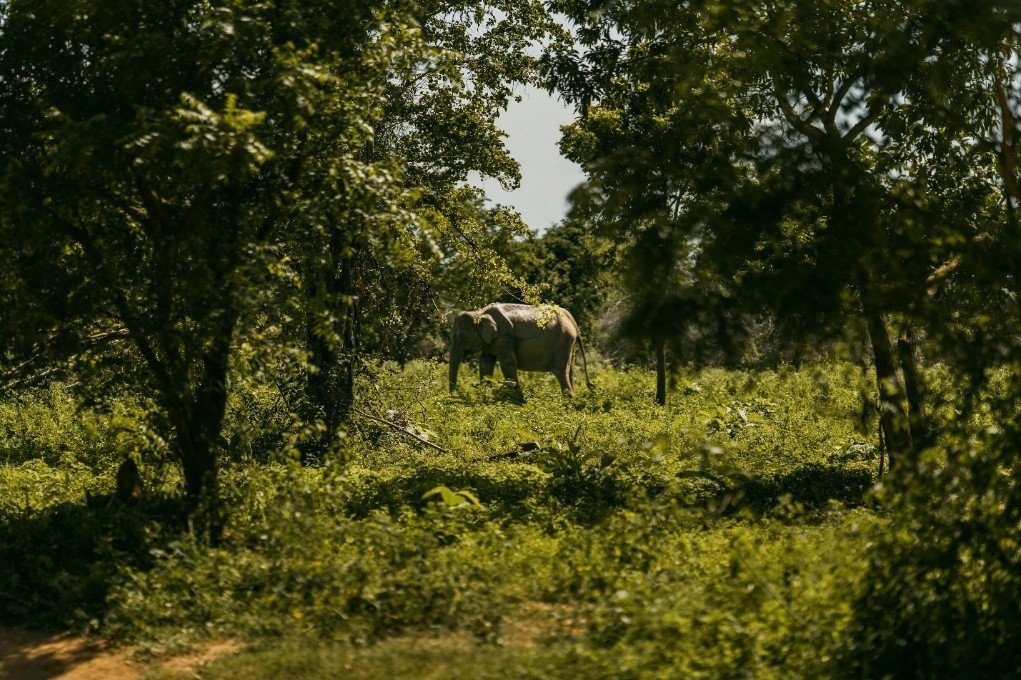
- Ecosystem Engineers.
- Creating clearings.
- By feeding on shrubs and small trees, elephants open up forest canopies, allowing sunlight to reach the ground. This encourages the growth of grasses and other plants, which benefits smaller herbivores and increases plant diversity.
- Maintaining Savannahs.
- In savannah ecosystems, elephants help prevent bush encroachment by knocking down small trees and feeding on woody plants. This maintains open grasslands that support a wide range of species.

Scientists that appreciate the fact that elephants are constructive rather than destructive feeders have used elephants to successfully regenerate systems that had collapsed. In the Addo Elephants National Park (RSA), 42 elephants were translocated to the Kabouga section. Their reintroduction resulted in the restoration of ancient elephant migration corridors and the elephants revived the ecosystem functions. The net result was long-term biodiversity gains. An almost identical experiment was carried out in Zimbabwe in the Panda Masuie Forest Reserve with the same effects.
In conclusion, I will add that a number of tree species would simply become extinct were it not for elephants. There is an amusing story involving the famous Kew Gardens in the UK. They wanted to propagate Ilala palms (Hyphaene petersiana.) The botanists attempted to mimic the process of elephant digestion. They mechanically scarified the seeds, they subjected them to acid baths to simulate stomach acid and they subjected them to controlled fermentation to mimic the elephant’s gut microbes. Their attempts failed and they had to resort to feeding the seeds to a captive elephant to achieve reliable germination.

The most famous story that this mirrors is the story of the tambalacoque trees (Sideroxylon glandiflora) found in Mauritius. Botanist Stanley Temple proposed that the trees used to have a mutualistic relationship with the now-extinct dodo bird. He theorized that this was the reason why there were no young tambalacoque trees. He introduced turkeys to mimic the dodo’s digestive system as both turkeys and dodos were gastroliths – they used grinding stones in their gizzards to aid digestion. He fed 17 seeds to turkeys, 10 passed through the gizzard and three successfully germinated.
There is absolutely no doubt that a lot of destruction takes place when elephants exceed the carrying capacity of an area, but please do not blame the elephants – blame poor management. By the way, did you know that elephants would never have chosen to live in the Zambezi Valley or Hwange or Gonarezhou. They used to prefer the cooler climes like those found in Selous, Harare, Marondera and Nyanga. That is where the elephant cave paintings are found.
In conclusion, elephants should not be viewed simply as agents of destruction, but rather as highly influential ecological engineers whose activities are essential to the health and renewal of many African ecosystems. While they can undoubtedly cause severe environmental damage when confined beyond the carrying capacity of an area, this is largely a consequence of human management decisions rather than any inherent flaw in the animals themselves.
Their role in seed dispersal, forest regeneration, habitat creation and the maintenance of biodiversity demonstrates that elephants are fundamentally constructive feeders operating within natural ecological processes refined over millennia. Far from being vandals of the wilderness, elephants are among nature’s greatest landscape architects, shaping and renewing the environments upon which countless other species depend

More to Explore


